
Has my IP been stolen?
Did you know that not every act of copying amounts to theft or infringement? So, before you ask your lawyer to send a cease-and-desist letter, it’s worth taking a moment to understand whether your IP has actually been “stolen”.
The truth is that the answer depends on the type of right you hold and whether it has been legally infringed under the applicable law.
This article aims to explain what intellectual property (‘IP’) is, what IP infringement entails, and the possible measures to take if your IP right has been infringed.
What is IP?
Intellectual property (IP) encompasses creative works comprising artwork, inventions, computer programs, trademarks, and commercial signs¹. IP rights essentially grants legal ownership over creative works and inventions enabling the owners to exercise exclusive rights and preventing others from using the IP without permission.
Intellectual Property rights are broadly divided into the following categories;
Patents: Protect inventions, processes, or novel methods of doing things.
Industrial Design: Industrial design rights encompass the aesthetic and ornamental aspects of a product, including its appearance and tactile qualities.
Trademarks: Protect company identifiers, including names, logos, slogans, and symbols.
Copyrights: Protect creative works, including books, music, films, artwork, and software.
Geographical Indications: Protect products that originate from a specific location and possess qualities, reputation, or characteristics essentially linked to that place².
What IP Is Not
Below, we demonstrate a decision tree on identifying some creative works that cannot be regarded as IP.
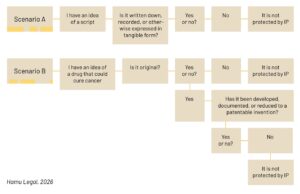
IP protection applies to the expression of an idea, not the idea itself. Ideas and facts, in their abstract form, are not protected by law. For example, copyright protects original works only once they are expressed in a fixed or tangible form such as being written, recorded, or otherwise documented.
Additionally, certain intellectual property rights, such as patents, trademarks, and industrial designs require formal registration before they can be enforced. Without registration, where required, legal protection may not arise.
What is IP Infringement?
Determining if your IP has been stolen requires factual and legal analysis specific to the type of right involved. The nature of infringement varies depending on the category of IP:
| Type of IP | What May Amount to Infringement |
| Copyright | Reproducing, distributing, performing, displaying, or adapting a protected work without authorisation. Courts typically examine whether there was access to the original work and whether there is substantial similarity between the works. |
| Patent | Making, using, selling, importing, or offering for sale a patented invention without the patent holder’s consent. The key question is whether the allegedly infringing product or process falls within the scope of the patent claims. |
| Trademark | Using a mark that is identical or confusingly similar to a registered trademark in a manner likely to cause consumer confusion as to source, affiliation, or endorsement. |
| Industrial Design | Applying or reproducing a registered design, or a design not substantially different from it, without authorisation for commercial purposes. |
| Geographical Indication | Using a protected geographical name for goods that do not originate from that location or do not possess the required qualities linked to that origin. |
In most intellectual property disputes, courts adopt a structured approach. They first determine whether a valid and enforceable right exists. They then consider the scope of that right and whether the alleged infringer engaged in conduct reserved exclusively to the rights holder.
Where applicable, courts may also assess issues such as substantial similarity or likelihood of confusion. Importantly, mere similarity does not automatically amount to infringement; it must meet the legal threshold prescribed by statute³.
What Should I Do If My IP Has Been Infringed?
If you suspect your IP has been stolen, you can take the following steps:
The first step will be to document the infringement. It involves compiling information related to the infringement. This can include taking screenshots, purchase records, or evidence of unauthorised use.
The next step will be to consult with a lawyer. A legal counsel can help determine the strength of your claim and potential remedies, and advise accordingly.
Typically, after your lawyer reviews the infringement and ascertains that you have a good claim, the issuance of a cease-and-desist letter may follow. A cease-and-desist letter is a formal notice sent from one party to another stating that the recipient’s activity is illegal and demanding that it stop immediately. It can sometimes deter infringers without resorting to litigation.
There is also the option of seeking administrative remedies. In Nigeria, complaints can be filed with regulatory agencies such as the National Office for Technology Acquisition and Promotion (NOTAP) or the Nigerian Copyright Commission, as applicable.
Finally, you can also take up court action. Depending on the type of IP, you may seek injunctions, damages, an accounting of profits, or the destruction of infringing goods. Nigerian courts have granted these remedies in copyright and trademark cases⁴.
If you don’t want to go all the way to court action, you can seek redress through alternative dispute resolution. Arbitration or mediation may be preferable for parties seeking faster, less adversarial outcomes.
If you suspect your IP has been stolen, you can take the following steps:
The first step will be to document the infringement. It involves compiling information related to the infringement. This can include taking screenshots, purchase records, or evidence of unauthorised use.
The next step will be to consult with a lawyer. A legal counsel can help determine the strength of your claim and potential remedies, and advise accordingly.
Typically, after your lawyer reviews the infringement and ascertains that you have a good claim, the issuance of a cease-and-desist letter may follow. A cease-and-desist letter is a formal notice sent from one party to another stating that the recipient’s activity is illegal and demanding that it stop immediately. It can sometimes deter infringers without resorting to litigation.
There is also the option of seeking administrative remedies. In Nigeria, complaints can be filed with regulatory agencies such as the National Office for Technology Acquisition and Promotion (NOTAP) or the Nigerian Copyright Commission, as applicable.
Finally, you can also take up court action. Depending on the type of IP, you may seek injunctions, damages, an accounting of profits, or the destruction of infringing goods. Nigerian courts have granted these remedies in copyright and trademark cases⁴.
If you don’t want to go all the way to court action, you can seek redress through alternative dispute resolution. Arbitration or mediation may be preferable for parties seeking faster, less adversarial outcomes.
Why Enforcement Is Crucial
Due to the global and digital nature of commerce, intellectual property is vulnerable to piracy, counterfeiting, and unauthorised exploitation. Failure to enforce rights undermines deterrence and encourages infringement. For example, reports from WIPO and the OECD indicate that counterfeit goods account for a significant portion of global trade, costing billions of dollars annually⁵.
Effective enforcement benefits both the creator and the economy, as strong intellectual property systems attract investment, encourage innovation, and foster fair competition.
Ultimately, intellectual property rights derive their true value not merely from registration, but from the willingness and ability of rights holders to enforce them when necessary.
Due to the global and digital nature of commerce, intellectual property is vulnerable to piracy, counterfeiting, and unauthorised exploitation. Failure to enforce rights undermines deterrence and encourages infringement. For example, reports from WIPO and the OECD indicate that counterfeit goods account for a significant portion of global trade, costing billions of dollars annually⁵.
Effective enforcement benefits both the creator and the economy, as strong intellectual property systems attract investment, encourage innovation, and foster fair competition.
Ultimately, intellectual property rights derive their true value not merely from registration, but from the willingness and ability of rights holders to enforce them when necessary.
